

In 2020, the professor of English and translator Shōichirō Kawai published a Japanese translation of the Folio Edition of “King Lear” (titled “The Tragedy of King Lear” ), with the aim of offering an accessible explanation of this production.
During our recent Zoom interview from his residence in Cambridge England, he offered a succession of highlights and key points to note for enhancing people’s enjoyment of the stage production.
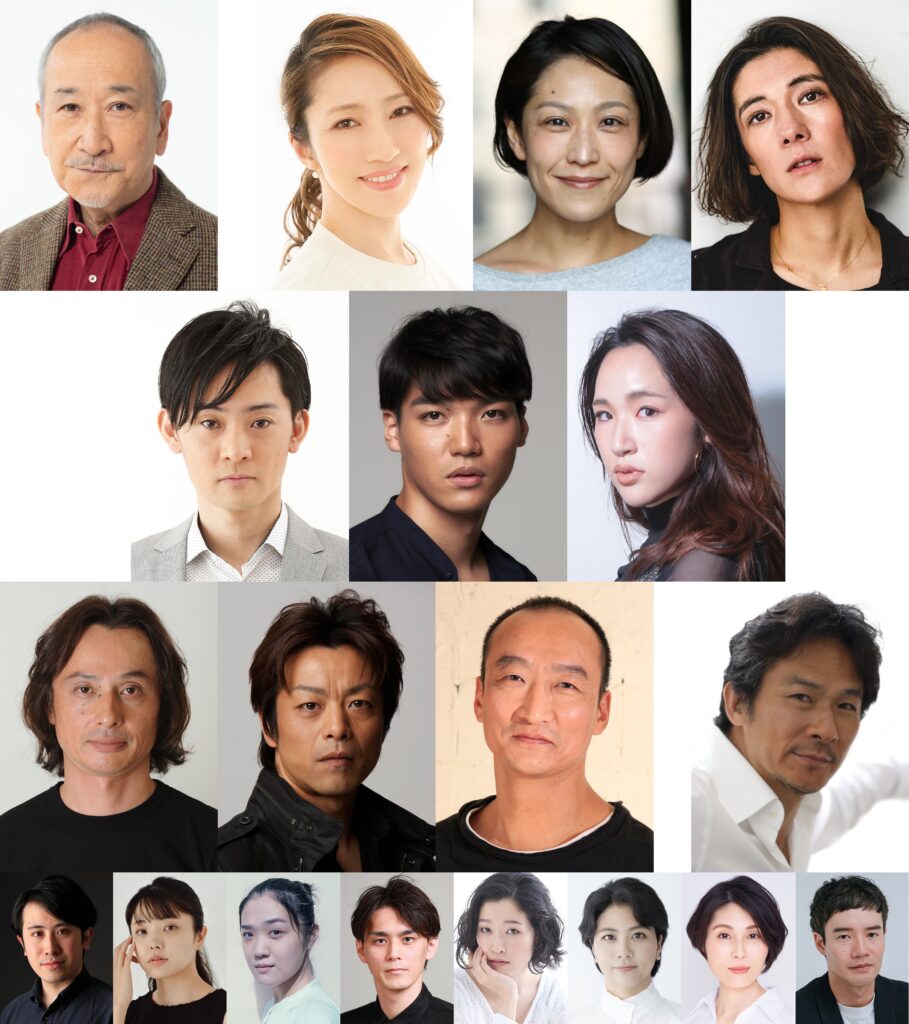
The cast of “The Tragedy of King Lear”
Could you tell us how this production of “The Tragedy of King Lear” differs from the versions of “King Lear” we’ve seen before?
Let’s begin with the fundamental question: are there actually two versions of “King Lear”?
To start with, the first edition published in 1608 was a quarto (four-fold) format, roughly the size of a modern paperback, and its title was “The History of King Lear”. On the other hand, after Shakespeare’s death, his associates published a complete edition of his plays in 1623 in folio format (a double-folded size). The title of the play included in that complete edition was “The Tragedy of King Lear”.
This complete edition contained 36 plays, most of which were reprints of the earlier Quarto Editions. Consequently, the text was generally unchanged from the Quarto Editions, i.e., the first printed versions. However, scholarly research has revealed that the texts of “Hamlet” and “King Lear” in particular were revised.
The overall plot remains the same, but for “King Lear” approximately 285 lines were removed from the Quarto Edition and replaced with around 120 new lines of dialogue (the exact count varies slightly depending on the method of counting). Differences include the removal of the Quarto’s verbose, lengthy soliloquies and the inclusion of very famous lines found only in the Folio Edition.
Until now, performances of “King Lear” have often used a hybrid version combining elements of both editions. Consequently, most previous translators have typically worked from this hybrid version.
In recent years, as research has progressed, criticism has grown that the so-called compromise edition, combining both versions, actually represents a version that never existed. Furthermore, research has clarified the distinction: the Quarto Edition reflects the drafts, while the Folio Edition reflects the revised performance text as finalised by Shakespeare. Consequently, even in Britain, the two are now increasingly published as separate works. Within academia, there is a growing awareness of the distinct differences between these two editions.
It is said that performances of “The Tragedy of King Lear” are relatively uncommon in Japan. How does the performance situation compare in other countries?
I cannot claim to have a complete grasp of all productions, but to my knowledge, performances using the Folio Edition — that is, staged as “The Tragedy of King Lear” — are rather uncommon. This is because the standard text available for reading was the composite edition, and everyone used it without conscious awareness.
What differences exist between the two versions?
In the Folio Edition, Edgar delivers the final line*, whereas in the quarto version, it is spoken by the Duke of Albany. Therefore, in actual performances, even when using the composite version, one must choose which character delivers that final line. In other words, up until now, each director has made that decision at the time. However, the phrase “we young men” is more fitting for Edgar than for the Duke of Albany. Since Shakespeare himself altered it in the Folio Edition, believing it better suited to Edgar, I think it would be preferable to follow that judgment.
My Kadokawa Bunko edition of “The Tragedy of King Lear” includes appendices listing both deleted and added lines, so it might be interesting to consult the book and compare these elements.
*“The oldest has endured the most. We young ones shall not live so long a life so full of sorrow.”
Among King Lear’s three daughters, the eldest, Goneril, and the second, Regan, are portrayed as being wicked. In the Quarto Edition, these two are depicted as picture-perfect, fairy-tale-like wicked sisters. These wicked sisters torment the youngest daughter, much like Cinderella. In the Folio Edition, however, they are made to say things like, “Father, that is cruel”. They are given lines that properly explain why they behaved that way.
For instance, the Folio Edition omits the passage from the Quarto Edition where Goneril’s husband, the Duke of Albany, hurls abuse at his wife, calling her a “Tiger, not a daughter … So horrid as in woman”.
Conversely, the Folio Edition adds a passage where Goneril states that if Lear, having promised to relinquish the kingship while his knights continue their insolent behaviour, that cannot be tolerated for the sake of the kingdom’s stability. This explicitly incorporates the daughters’ intentions into the dialogue. Consequently, I believe the Folio Edition presents a more contemporary narrative. In recent years, there was the Otsuka Furniture company dispute over management rights between father and daughter — a tale reminiscent of that very turmoil; a story that transcends time.
In previous productions, it tended to become a domestic drama about wicked daughters and a betrayed father, but I personally believe it is more of a political story. Moreover, this Folio Edition version we are staging now meticulously depicts what happens to a person when their values undergo such a profound shift — specifically, when Lear, who once wielded immense power, loses it and must confront his daughters as a mere mortal.
My favourite scene is the reunion between Lear and Cordelia, where Lear kneels before her, begging forgiveness. Cordelia immediately stops him, but Lear refuses to rise, declaring, “I am a very foolish-found old man”. Nowadays, one might not be particularly surprised to see a father behave thus towards his daughter, but for a father — and indeed a former king — to display such an attitude towards his daughter in those times was extraordinary. It strikes me as a profound story: the king, before whom all once prostrated themselves, finally sheds all his former trappings in the storm and is able to relate to his daughter as a human being.

Is that perhaps why Professor Kawai was drawn to the Folio Edition in the first place?
Indeed. Interestingly, as I translated, I came to realise that Cordelia isn’t necessarily just a good girl.
She could have been a little more considerate of her father’s feelings from the start and treated him more gently. Yet, Cordelia herself provoked her father’s anger precisely because she was trying to defend her own righteousness. Moreover, later on, when Lear suggests they live out their days together in prison, she remains utterly silent, offering no response whatsoever. This echoes Cordelia’s declaration at the play’s outset: that while she loves her father, once she marries, her life will be devoted first and foremost to her husband, the King of France. Ultimately, this ending reveals that even at this moment, Lear still fails to truly understand her.
In this way, Shakespeare has woven profound lines and passages throughout the text.
Could you tell us the highlights of the Kawai’s translation of “The Tragedy of King Lear”, which marks its Japanese premiere?
This time, I particularly hope audiences will notice how Goneril and Regan embody ways of thinking common among modern people.
Goneril, being the eldest daughter, feels the greatest responsibility for the kingdom’s stability and, in that sense, inherits Lear’s values. Regan, on the other hand, doesn’t seem to consider such things at all. Director Fujita and I analysed that she might simply be jumping on the bandwagon of what others are doing, just to prove she’s superior.
With Mai Morio, who excels in any role, portraying such a Regan, I personally have nothing but high expectations for her Regan.
Furthermore, in Fujita’s production, Mahya Harada takes on the dual roles of Cordelia and the Fool. This approach is, of course, based on scholarly theories suggesting such staging was common in Shakespeare’s era. This too is one of the production’s highlights, I believe.
Regarding Oswald (Yukio Tsukamoto), in most productions he is merely portrayed as a butler who treats Lear harshly, simply obeying his master Goneril’s commands. However, this time, if you view him from the perspective of which side he will take when values shift, I believe you will discover a different kind of enjoyment. As we too live through shifting eras – Showa, Heisei, Reiwa – and changing values, adapting to new ways of thinking, might we not see this very human condition reflected in Oswald?
Naturally, the casting of Kate Doi, a woman, in the role of Edmund is also a highlight.
How do you perceive the significance of staging this “Tragedy of King Lear” at KAAT under the theme of “Somebody”?
Rather than the “King Lear” everyone knows, this production confronts us with the question: who are we, living amidst this shift from old to new values?
Even as eco-consciousness and sustainability are increasingly championed these days, I cannot help feeling that ultimately everything shifts back to the economy, and we are merely finding compromises centred around it.
Amidst the storm, Lear returns to nature and only when he recaptures humanity’s fundamental essence does he truly consider his subjects and the poor.
In other words, I believe this work contains something we have lost: the compassion for others and the understanding of the importance of coexisting with nature that we have forgotten, sheltered by technology and living comfortable lives today. In that sense, it is a story that strongly resonates with us now.
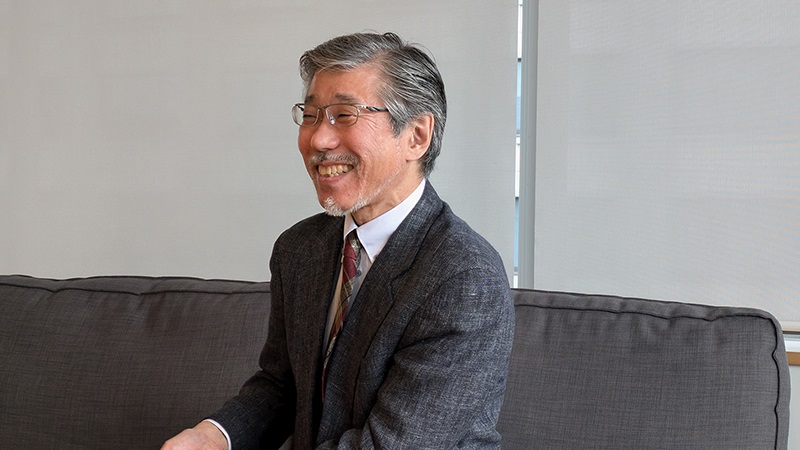
Shōichirō Kawai
Shōichirō Kawai’s “New Translation: The Tragedy of King Lear” is published by Kadokawa Bunko.