
Timofey Kulyabin famously staged his production of Chekhov’s “The Three Sisters” entirely using Russian Sign Language at the Tokyo Arts Festival’s “Geigeki Autumn Selection” in 2019 in a performance that opened the eyes of many theatregoers.
Now, the 42-year-old Russian-born artist is at last returning to the Tokyo Metropolitan Theatre — this time directing Henrik Ibsen’s 1879 masterpiece, “A Doll’s House”.
The production, titled “Nora”, is based on Ibsen’s renowned original work, which is widely regarded as the beginning of modern theatre.
The plot of “A Doll’s House” — which is also often cited as a pioneering work in the cause of women’s liberation and feminist theatre — centres on the protagonist Nora, a “doll” who was seemingly bound to her husband and home, but leaves her kids and family behind.
Kulyabin, who is currently based in Europe, transposes the story to the society in which we live today, depicting the evolution of Nora’s inner world through the medium of human communication via smartphones — devices we never put down in our daily lives.
Consequently, in addition to memorising the story and lines, the cast members are required — as a vital part of their performance — to master the technical skills of operating smartphones to type their lines as messages whilst on stage. Those messages are then projected onto a screen in real time and are shared with the audience.
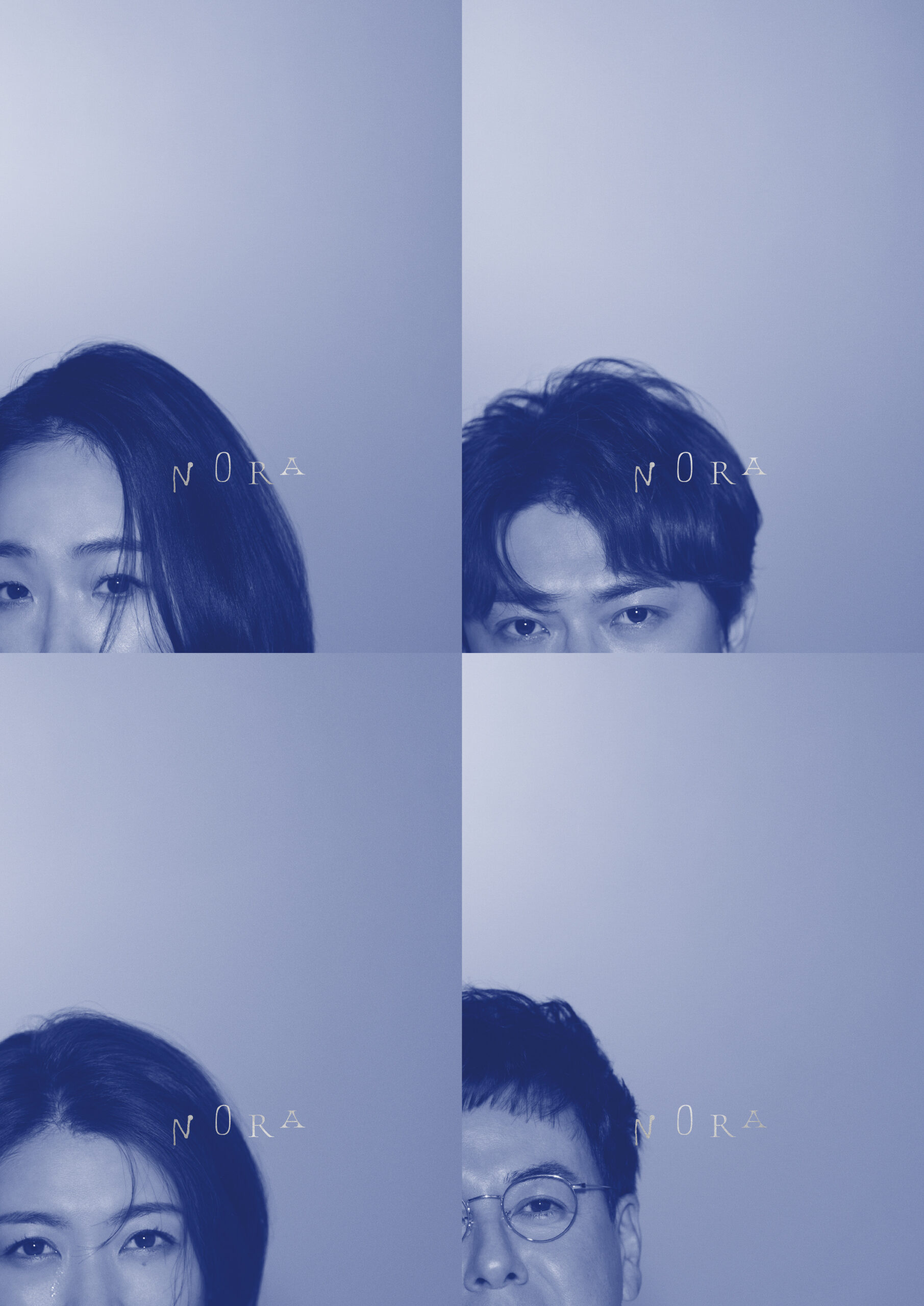
The cast, who are honing these new acting techniques daily in the rehearsal room, includes Haru Kuroki as the protagonist Nora; Ryo Katsuji as her husband Helmer; Kumi Takiuchi as Nora’s long-time friend Christine; and Kosuke Suzuki as Krogstad, who threatens and corners Nora.
Jstages.com visited the rehearsal space as the opening approached and spoke to director Kulyabin about the connections within modern families — expressed through smartphone exchanges — the distortions in communication that lie beneath them, and the staging techniques utilising Japanese text input that unfold on stage.
(c) Nobuko Tanaka
Why did you choose to have the characters communicate via text messages?
One of the things I am constantly exploring is whether it is possible to approach interactions and acting on stage in new ways.
The reason we opted for this smartphone-based approach was, firstly, that we wanted to express ourselves through a completely different form of communication; and secondly, because smartphones have become an indispensable means of communication in our daily lives over the past 15 years or so. We wanted to explore what might emerge if we adapted a classical work — one that has been performed hundreds of times in various venues — to the means of communication we use today.
What sort of discussions did you have with the Japanese actors in the rehearsal room?
I feel very fortunate to have such a wonderful cast. I believe we understand one another very well. In co-productions such as this, I am careful not to become a dictator. Therefore, I am very open to suggestions from them. They have put forward some interesting ideas this time too, and I am currently incorporating them into the creative process.
As for Haru Kuroki, she’s boldly taking on this major role, in which she’s on screen almost non-stop. There are lots of costume changes, and when it comes to the smartphone, it’s not just a matter of exchanging lines — there’s the difficulty of timing it all. So there’s really a great deal to do. Amidst all this, where she has to do so much technically as well as simply acting, she’s delivering a truly magnificent performance; I’m actually falling in love with her (laughs).
I imagine there are differences between how smartphones are used in Europe and Japan — what are your thoughts on that?
First of all, smartphones themselves have undergone revolutionary changes over time, haven’t they? For example, when we premiered this production in Switzerland (in 2018), voice messages didn’t yet exist. As smartphones continue to evolve, we’ve had to make adjustments, such as incorporating voice messages into the staging.
The last time we performed this was in Sofia, Bulgaria, four years ago, and we made similar changes then as well.
Also, whilst the WhatsApp app is popular and widely used in Europe as a communication tool, the actors and staff pointed out that Line, rather than WhatsApp, is the mainstream app in Japan, so we decided to use Line. I installed the Line app straightaway, too.
What new insights have you gained from this re-creation in Japan?
The premiere was in Switzerland in German, and the second performance was in Bulgaria in Bulgarian, but this time it’s in Japanese, so the language is completely different. For example, during the European performances, we used a stylistic device where text displayed on screen was in alphabet, so we emphasised sentences by writing them in capital letters; however, this doesn’t work in Japanese. So the actors have come up with various creative solutions, such as making extensive use of ‘emoji’ to achieve a similar effect.
Whilst there is what you might call a script, the way it is transcribed as text on screen differs. For instance, if there is a single sentence, they might split it up and send it in two or three parts, or combine two sentences into a single transmission. I believe how they handle this will depend on their mood at the time, so I’ve left it entirely up to the actors. As I believe it depends on their mood at the time, and since I’ve given the actors complete freedom, I don’t think you will ever see exactly the same performance even if you watch it two or three times.
What has changed and what has remained the same between Ibsen’s original work, written some 150 years ago, and this production?
Women’s independence and feminism are themes that have existed throughout the ages. In the end, Nora leaves home, leaving her child behind, in order to reclaim her sense of self. Women’s independence lies at the heart of this Ibsen play and is a theme of great significance. I believe it is something that should be portrayed in any era.
The development of the internet and the widespread use of smartphones have made us feel as though distance no longer exists. For example, I speak to my family in Europe every day using WhatsApp. In the past, it used to be a real struggle — you had to apply for an international call and only then could you finally get through. But now, no matter where you are in the world, you can connect instantly, so distance is no longer felt. I feel that this sense of physical distance is disappearing from people’s lives.
On the other hand, might this technology also be increasingly isolating people? Nowadays, we are becoming completely unconcerned even if we cannot speak to another person face to face.
Furthermore, for deaf people this text-based communication has been a lifeline, broadening their world.
So, whilst there are both positive and negative aspects to technological development, I believe that communication via smartphones — including emoji — constitutes a language in its own right. The characters appearing in this production of ‘Nora’ do exchange spoken dialogue, but the vast majority of the communication — around 80 per cent — is by typing text or sending voice messages.
Watching this, I am struck by the realisation that it is no different at all from a play where the characters speak normally. It is simply that the spoken words have been replaced by typed words; there is no difference whatsoever. I believe that this form of text-based communication has now firmly established itself as a new language in its own right.
To give an example: when I, living in Berlin, decide to go to Japan, I use this smartphone to book my flight and hotel, call a taxi via my smartphone to get to the airport, and once I arrive in Japan, I do the same — calling a taxi via my smartphone, checking in via my smartphone, using my smartphone to get tickets for the play I want to see, and searching for and booking a restaurant after the performance. Before I know it, I’ve managed to do everything with just a single smartphone, without speaking to a single person.
I believe “A Doll’s House” is also a story of miscommunication, where words are exchanged but feelings are not conveyed. How will this aspect be portrayed in this production, which has updated the methods of communication?
When communicating via smartphone, for example, you can send a message saying ‘I’m so happy’ even though you’re actually angry. You can also delete a message before sending it. Actually, when you speak face to face, facial expressions make it difficult to lie, but using a smartphone makes it easy to deceive others. It becomes easier to lie; in other words, whilst new technology seems to make communication easier, it makes it more prone to distortion. I believe this resonates well with the play.
In his message ahead of the production, your dramaturg, Roman Dolzhanskiy, said: “What matters most is how it is told. We decided to tell a story written by Henrik Ibsen a century and a half ago in the language of contemporary communication.” What are your thoughts on that?
I believe “Nora” (“A Doll’s House”) is probably one of the most frequently staged plays in the world. That is why I think how it is presented is so important. I believe that is what constitutes a new interpretation. Whilst the content remains the same, there are hundreds of ways to present it.
Why do you continue to create works based on classical texts, such as ones by Ibsen and Chekhov?
I am very interested in staging famous plays — ones that have been directed using a wide variety of approaches over the years — with my own unique interpretation, and I am drawn to taking on such challenges. The more famous a play is, the more varied the ways it has been staged in the past, so it is incredibly fascinating to create a production of such a play in my own way, in a manner that has never been done before.
I understand you are due to take up the post of Chief Director at the State Theatre in Cottbus, Germany, this summer. What do you hope to promote within the German theatre world, which is often described as avant-garde and political?
Cottbus is a city near the Polish border. Mr. Dolzhanskiy the dramaturg on ‘Nora’, will also be working there with me.
At that theatre, we are planning to invite various directors from neighbouring (former) Eastern European countries, such as Poland and Romania, to try out new approaches. Whilst it may seem that a great deal is happening in the German theatre world, it is actually quite insular; we want to do things that are more open to the world, and we intend to make the Cottbus State Theatre a more international venue.
In this modern age of technological advancement, what is the role of theatre — of attending a performance at a set time?
When watching a play in a theatre, a sense of unity arises between the performers and the audience, and an exchange of energy takes place between them. Furthermore, I believe that when strangers gather in the auditorium and watch the same performance, a shared emotional experience develops amongst the audience. Consequently, although people may arrive as strangers, by the time they leave, they all depart with a profound sense of shared empathy. The theatre is a place where such a sense of unity can be achieved.
‘NORA’
Tokyo Performances
Dates: 15 July (Wed) – 26 July (Sun) 2026 (15 performances in total)
Venue: Tokyo Metropolitan Theatre, Playhouse
Details: https://nora.geigeki-classics.jp
Miyagi Performances
Date: Saturday 1 August 2026
Venue: Ezuko Hall, Main Hall
Aichi Performance
Dates: Saturday 15 August and Sunday 16 August 2026
Venue: Kasugai Civic Hall