
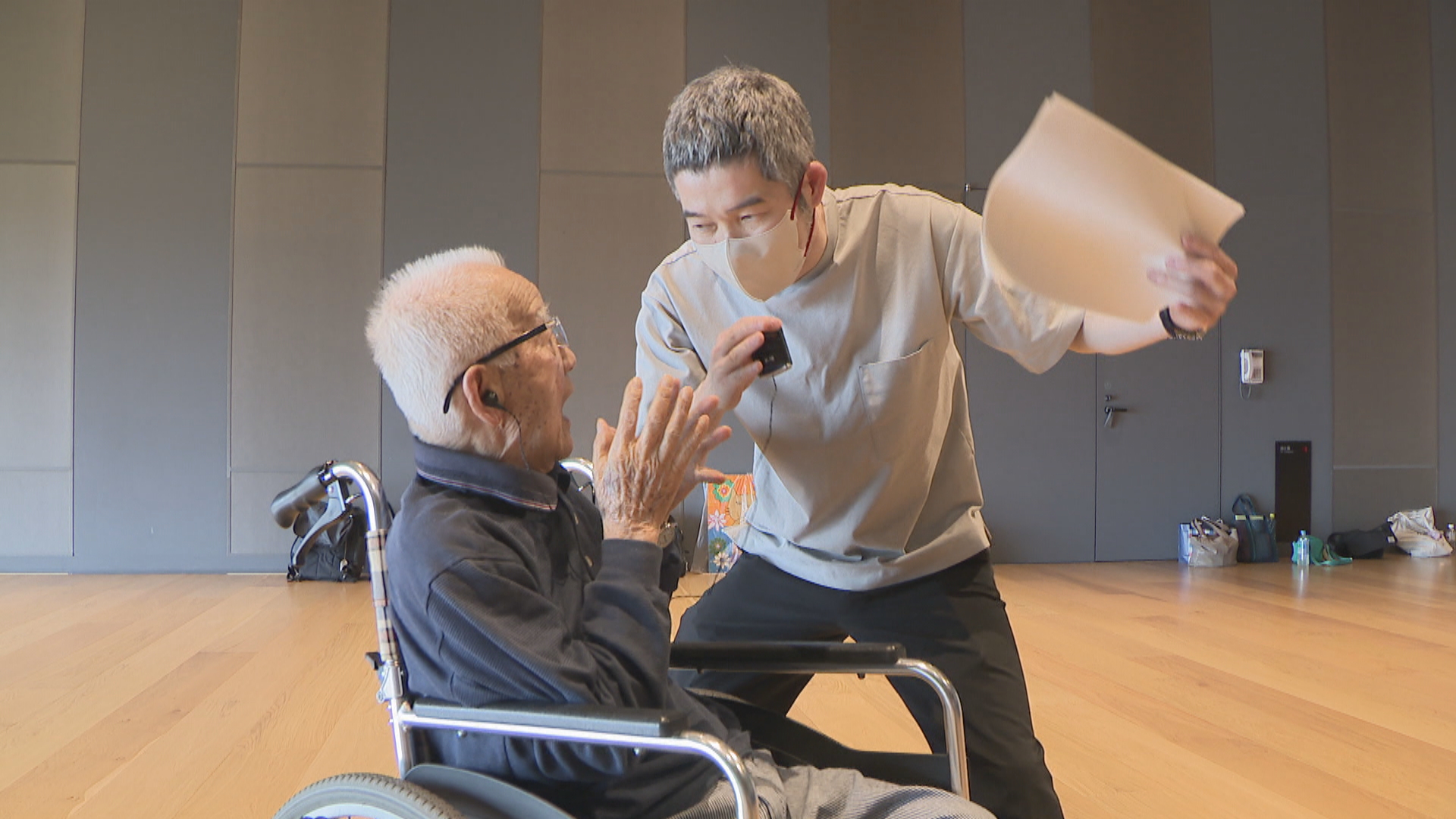
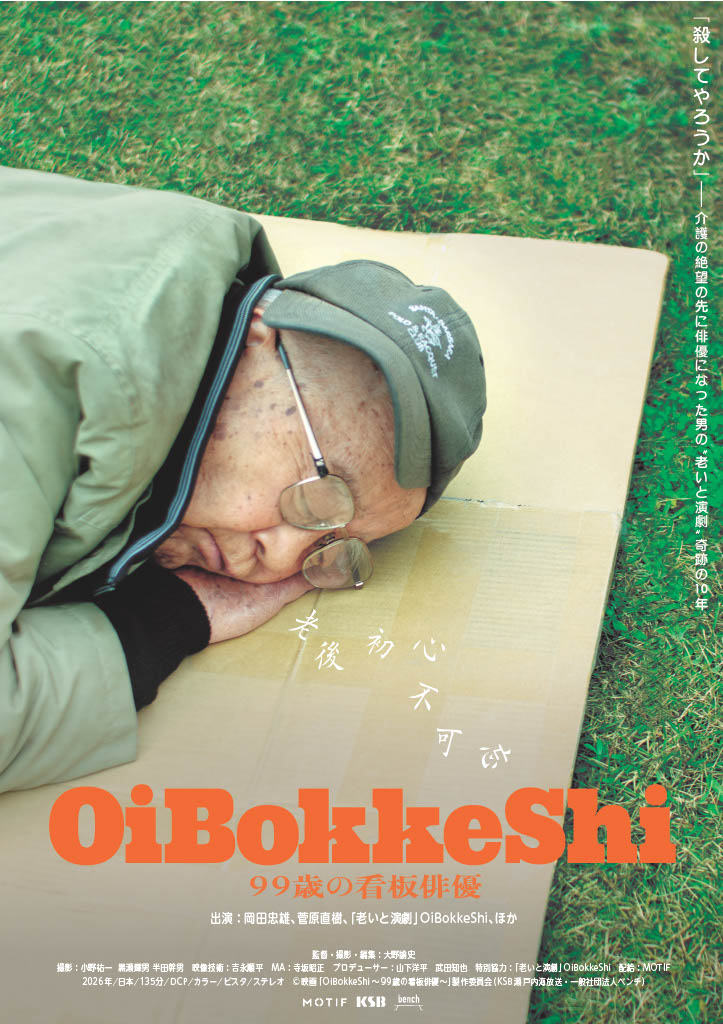
Have you heard the name of Tadao Okada, known as ‘Okajii’, the actor who made his stage debut at the age of 88 and continued to perform right until just before his 100th birthday? This documentary film, ‘OiBokkeShi: The 99-Year-Old Leading Actor’, is a miraculous record capturing the way of life of Okajii — a man who devoted his entire being to the theatre—and portraying him as an actor right up until the day he passed away.
Okajii, who became a participant in the first-ever theatre workshop organised by Naoki Sugawara, was an actor and certified care worker, who focused on the themes of ageing and theatre and spent his days striving with an unending spirit of inquiry to master the craft of acting, a profession that had long been his dream.
At home, where his wife—who suffered from dementia—awaited him, Okajii would often end up shouting at his uncooperative partner; however, through the ‘Ageing and Theatre’ workshop, he discovered a theatrical solution to his communication issues with his wife, put it into practice himself, and gradually improved their relationship.
From the record of Sugawara and Okada’s 12 years of theatrical creation, we may discover the secret to enabling the elderly to shine in Japan—a society now entering a super-ageing era —and show how those around them can benefit from that radiance.
How can we stride cheerfully along the path that everyone must eventually tread—‘Oi (ageing), Bokke (dementia), Shi (death)’? To castlight on this, we asked Naoki Sugawara to share his many memories of Okajii.
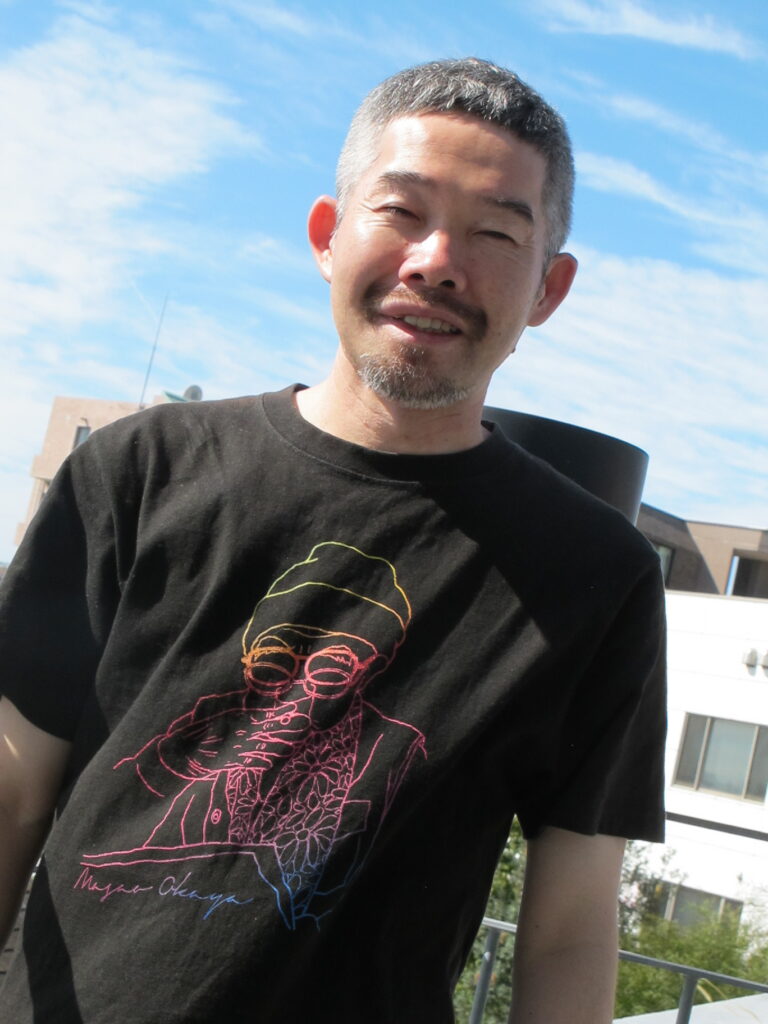
Naoki Sugawara
You have been pursuing theatre work under the theme of ‘Ageing and Theatre’; why did you decide to capture this on film in the form of a documentary?
Fortunately, the KSB (Setonaikai Broadcasting) and OHK (Okayama Broadcasting), local broadcasters in Okayama, have been following OiBokkeShi’s activities and have produced documentaries of around 30 to 60 minutes in length. Okajii (Tadao Okada) originally came from the film industry and had appeared as an extra in films by director Shohei Imamura, such as “Kuroi Ame (Black Rain)” and “Kanzo Sensei (Dr. Kanzo)”, as well as in films by other renowned directors. He had originally worked as a hotel manager, but after retiring, he took up the performing arts he loved, such as theatre and traditional Japanese dance. As he was particularly fond of films, it all began when he was given the opportunity to appear as an extra in “Black Rain”, which was set in his hometown of Okayama. It seems he visited the film set every day during the location shoot.
Then, when Okajii was 88 years old, he took part in a workshop I organised, which is how we met.
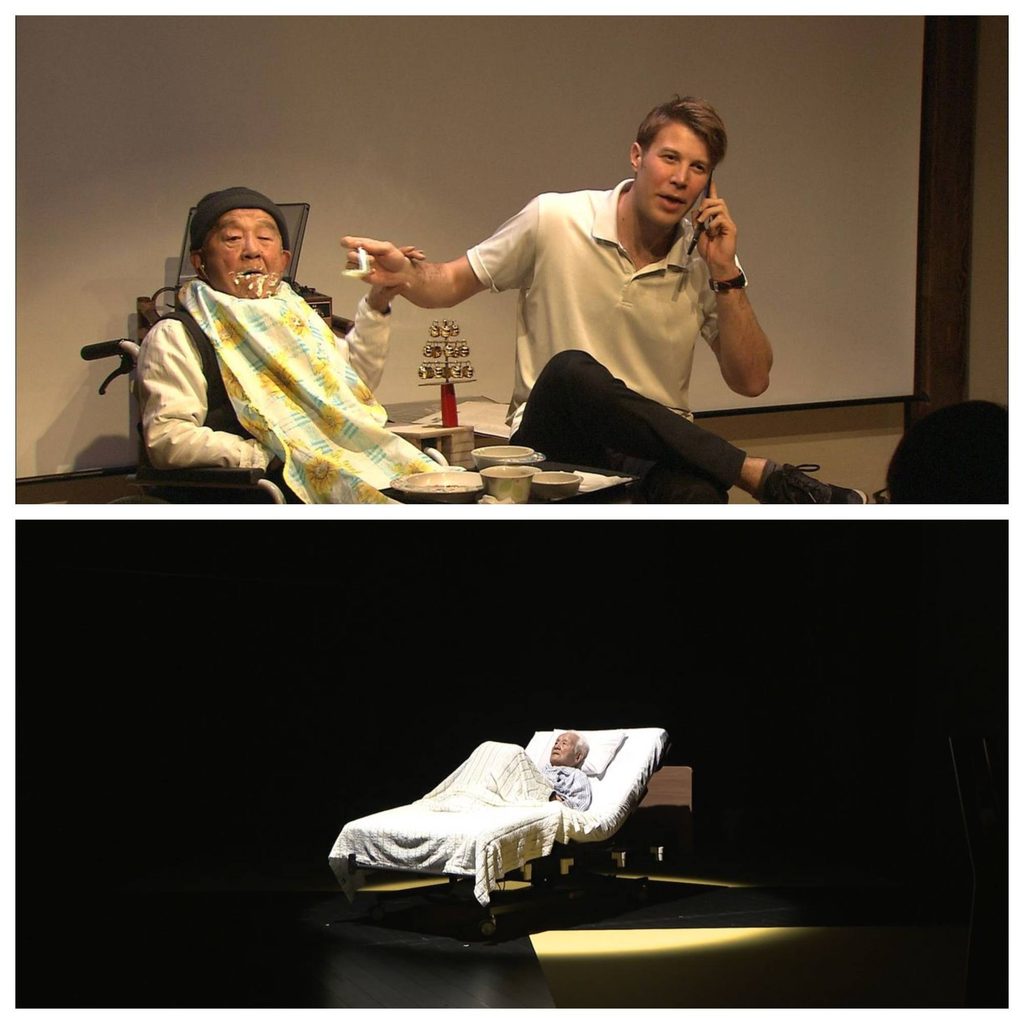
Stage photos
He has been working as OiBokkeShi’s leading actor ever since, and as he was due to turn 100 this year *, this film project was launched with the aim of creating a film starring Okajii—who had previously appeared in films solely as an extra—in the lead role. With the aim of showing the film to 100-year-old Okajii, we initially planned for it to cover the Kurume performance (July 2025) of “Love Is Aqua Blue” and were scheduling its release for spring 2026. With his 100th-birthday commemorative performance in May 2026 just around the corner, he passed away suddenly in March. So we included additional footage covering his death. As a result, I believe it has become a miraculous work depicting Mr Okada’s ‘Oi (old age), Bokke (dementia), Shi (death)’ in a film packed with his life as an actor.
By chance, I was able to visit Mr Okada the day before he passed away; despite being paralysed on one side, he raised his fist and declared, ‘The stage is my life.’ I truly believe he never gave up on the stage, right up until the very end.
*In March and May 2026, whilst preparing for new productions, he suffered a stroke and passed away due to aspiration pneumonia.
As people grow older, they often suffer from illness or disabilities and find themselves having to give up various things. Okajii continued to smoke even after turning 90, but after suffering several strokes, the doctor eventually told him, ‘It’s either the cigarettes or the stage,’ and he chose the stage. Even after moving from his home to a care home and being forced to stop walking, Okajii never once gave up on the stage, even whilst confined to his bed. That has stayed with me as a powerful message.
I understand that, whilst working as an actor with the Seinen-dan, you obtained a qualification as a care worker and began working in the care sector. What prompted you to enter the field of care?
I’ve loved theatre since my teens, so I went to Obirin University, which unusually has a Drama course, to study it, and that’s where I met a prominent playwright and director Oriza Hirata. After graduating, I appeared as an actor in productions within the Seinen-dan** theatre company. Once I was past my 20s, I got married and had a child, and I thought it would be better to do something a bit more specialised, even if it was just part-time work. My own grandmother had suffered from dementia and I’d had some difficulty dealing with her behaviour. How I should have responded in those situations remained a mystery to me for a long time. So, I chose a career in care work, hoping that I could confront the mystery of dementia through that work. Another reason I chose care work was that, as communication is so important in theatre, I thought a job involving face-to-face interaction with people might suit me better than working on a computer. I was anxious at first, but once I actually started, I found it fascinating. It’s enjoyable to listen to all sorts of people’s stories, and even with people living with dementia, depending on how you communicate, there are many moments when you can truly connect – it’s genuinely rewarding.
**A theatre company founded in 1983, centred around the playwright and director Oriza Hirata. Based primarily at the Komaba Agora Theatre—where Hirata serves as artistic director —the company has produced a body of work characterised by contemporary spoken-language theatre, exerting a significant influence on the Japanese drama scene since the 1990s.
At first, I was juggling both acting and care work, but after trying it to do that for about a year, I began to feel that I wanted to focus more on care work, so I shifted my priorities in that direction.
I realised that whilst many elderly people tend to find themselves gradually stripped of their roles and end up simply staring blankly at the television all day, they are actually seeking a sense of purpose. These are people who have lived their lives fulfilling various roles. I think care work is often perceived simply as looking after older people, but in reality, the most rewarding aspect of providing care is the moment when an older person is asked to do something and their face lights up with vitality. Whether it’s cooking or something related to the work they used to do, finding such an activity brings a real spark to their lives.
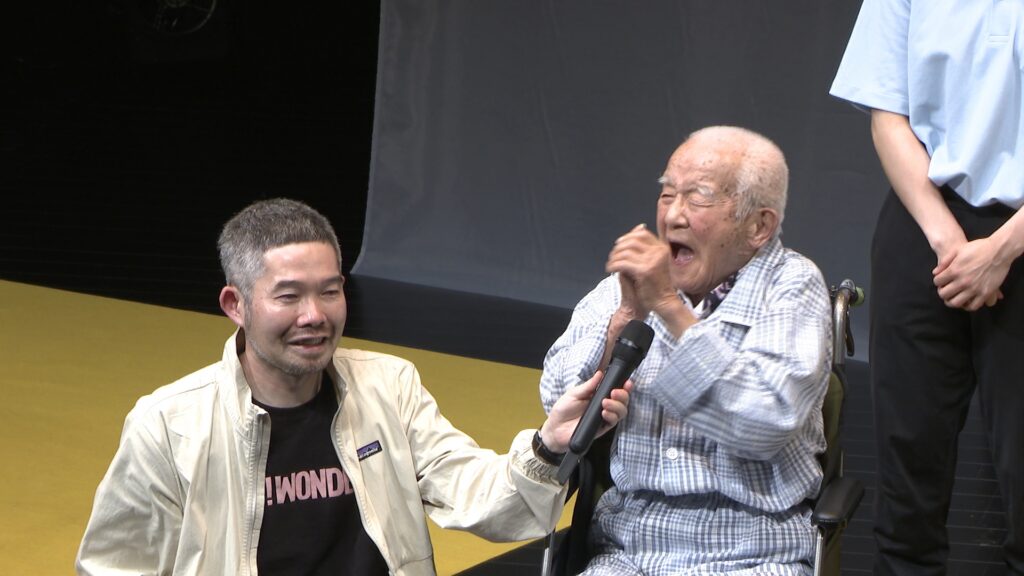
Okajii at a curtain call and pleased to see the audiences
Whilst care work involves assisting with meals, toileting and bathing, I believe that finding a role suited to each individual is also a vital part of the job. And it is, in fact, a highly creative endeavour. As everyone’s life is different, we listen to each person and work together to find a role that suits them.
I realised this is rather like the work of a theatre director: assigning roles to actors, interpreting the script, arranging the set design and other elements, and enabling the actors to perform with vitality on stage. Viewing care through the lens of theatre, I came to realise that it is, in fact, about ‘roles’. Older people are seeking a role to play, and I believe there are no better actors than older people.
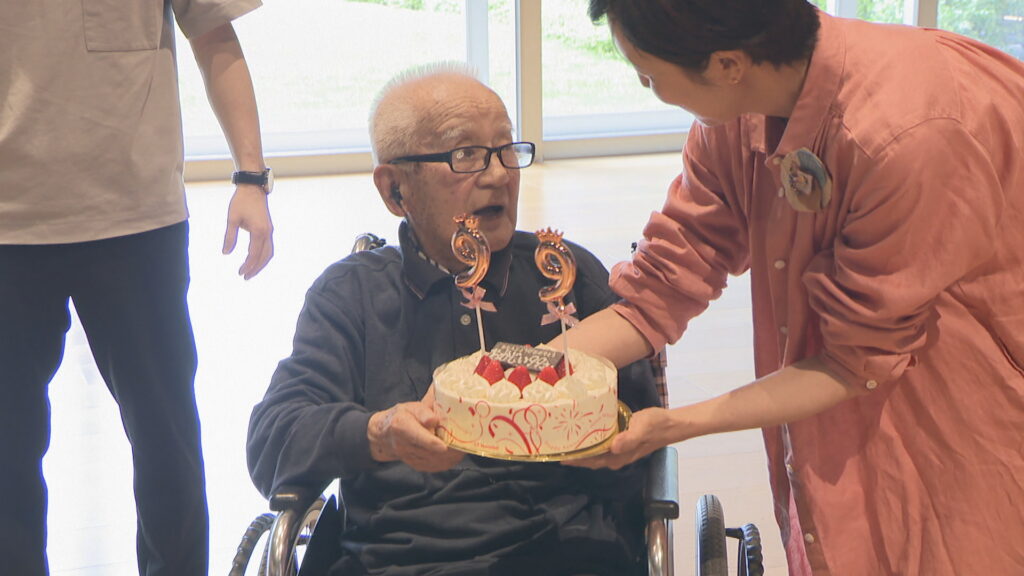
Celebrating Okajii’s 99-year-old Birthday
There are many behaviours within care homes that are often regarded as problematic—such as a desire to return home or wandering around the premises—and staff usually respond by saying, ‘Let’s go back to your room.’ However, when you look into a person’s background, you might discover he/she used to be a security guard. In that case, it’s no longer a problem; you realise he/she might simply have been patrolling the premises, and your perspective changes. It then becomes a matter of simply accompanying them on their nightly rounds, and that’s where the insights from their life experience lie. I found that approach incredibly fascinating.
You launched ‘Ageing and Theatre’ (OiBokkeShi) in 2014 – what prompted you to start it?
In the aftermath of the Great East Japan Earthquake in March 2011, thinking that as care homes could be found anywhere in the country, it wouldn’t really matter where we settled. So my family and I decided to move to Wake Town in Okayama Prefecture. After working in a care home for about two years, I began to feel that ‘there are no better actors than the elderly’ and that ‘caregivers should become actors too’. Based on these two realisations, I decided to form a theatre company in Wake Town and set about recruiting local people.
Given the belief that there are no better actors than the elderly, I initially wanted to create a play together with them. However, realising that many people would struggle to understand the connection between care work and theatre, I first organised a theatre workshop to allow them to experience that connection for themselves. This was conceived based on my conviction that carers, too, should become actors. Furthermore, as theatre is not familiar to many Japanese people, I also hoped to use care and ageing as a gateway to help them become more familiar with the art form.
That’s where you met Okajii, wasn’t it?
That’s right. He was the first to arrive at the very first workshop in June 2014; he was there an hour and a half before it started.
Okajii, whose wife had dementia, has said that he was ‘saved by accepting her dementia through “acting.” How do you interpret the true meaning behind that?
The workshop focuses on the behaviour and remarks of people with dementia that might make you think, ‘Hang on a minute?’—in other words, issues relating to memory impairment and disorientation. For example, when someone calls me a ‘watchmaker’ or mistakes me for their son, rather than simply denying it, the workshop suggests that it might be better to engage with them in a way that accepts these moments. For instance, if they call you a ‘watchmaker’, you might reply, ‘Is there anything you need help with your watch?’ and they might respond, ‘Yes, there is.’ The workshop was designed to let participants experience first-hand that such communication is perfectly acceptable—that it is perfectly fine to accept these cognitive discrepancies rather than correcting them every single time.
At the time, Okajii was 88 years old and hard of hearing. Although the workshop was themed around ageing, I hadn’t expected someone of such advanced age to take part, so I was anxious about whether he would be able to manage it. I wasn’t sure to what extent he had grasped the concept of acting to accept the behaviour of someone with dementia. An NHK reporter covered the workshop, and when I saw the footage of Okajii practising this approach—acting to accept his wife’s ‘senility’ whilst caring for her—I was truly taken aback.
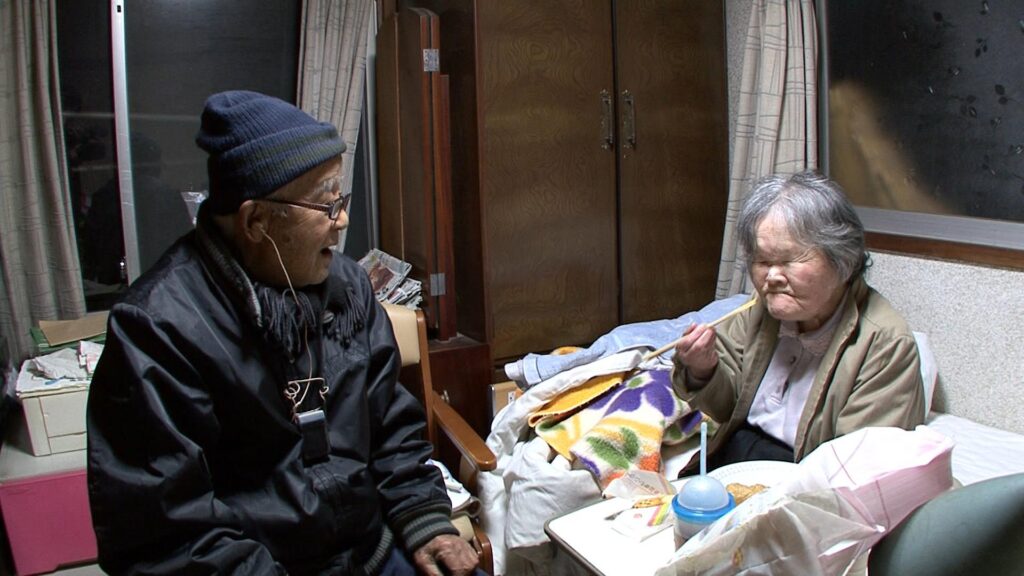
Okajii looked after his wife at home
For example, suppose his wife says, ‘I’m resigning today,’ and tries to leave the house. Up until then, in such situations, he would shout, and it would escalate into an argument; however, after attending the workshop, he would mentally click his clapperboard and say, ‘Ah, in that case, I’ll pay you your severance pay, so please fill in the paperwork here,’ thereby buying time and ultimately accepting the situation. He himself said that arguments had become less frequent since then. Caregivers believe they are in the right, so this is a response that seems possible but is actually quite difficult to put into practice. I deal with this as part of my job, and as I’ve been involved since the onset of dementia, I have a certain amount of perspective; but I imagine it’s much harder for family members. It would be a shock if one’s own mother forgot who you were, and it’s very difficult to reach the point where you can accept that and ‘play along’. Okajii managed to do this within his marriage—and in the particularly challenging situation of elderly-to-elderly care—and I thought he was truly remarkable.
I think that taking part in the workshop and meeting you made a real difference to Okajii’s final years, but I also believe you gained a great deal from Okajii.
There were so many different things I received from him. Above all, he taught me the power of theatre. He showed me what it means to put acting into practice in everyday life, and that there are people for whom theatre is a source of life – people for whom the stage is their very life. During the COVID-19 pandemic, there was a debate about whether theatre was unnecessary, but for Okajii, it was absolutely indispensable.
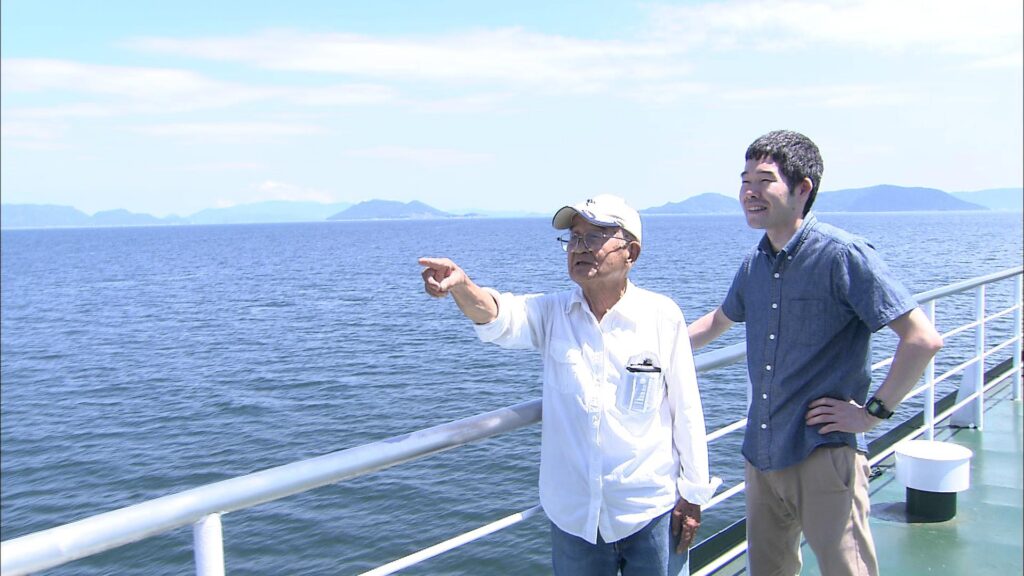
Okajii and Sugawara
I do think Okajii was a rather unique individual, but I believe that through the way he lived his life, many of you will have had moments of realisation or been struck by something. He taught me that even in old age, even with dementia, and even when death is imminent, people still have the potential to shine. As we grow older and there are more things we can no longer do, we tend to give up on meeting people or on the activities we used to enjoy, and our lives become confined almost entirely to the home. Yet, by taking a certain approach, there is still the potential for that life to shine. I believe Okajii proved this on stage in a very clear and accessible way.
Okajii used to say that one of the unique aspects of theatre is that there’s no retirement age for actors: if you can no longer walk, you can play a role in a wheelchair; if you become bedridden, you can play a bedridden character; and in the end, you can even play a role inside a coffin. He also said that dying on stage would be his heart’s desire, and the conviction with which he spoke was truly remarkable.
Okajii used to tell everyone he met, ‘You should get on stage too.’ He would always say that everyone has their own strengths, and that these should be expressed on stage through a role. I truly believe that’s the case. Initially, at OiBokkeShi, we aimed to create a highly polished production featuring experienced theatre actors alongside Okajii; for that reason, there was a time when we gave Okajii some rather harsh criticism, but later we realised we’d been wrong. From then on, we shifted our focus to letting Okajii perform with real vitality, and we created works such as “Portable Toilet Theatre” (2018)—a play based on Okajii’s daily life—and a piece that recreated exchanges between him and his wife, as recounted by Okajii himself.
Your mentor, Oriza Hirata, has also left Tokyo and is now pursuing new theatre projects in Toyooka, Hyogo Prefecture. What are your thoughts on what you have inherited from Hirata?
When I was at secondary school, I took part in a workshop led by Oriza Hirata, and it was a real eye-opener. In that workshop, I learnt that theatre is not just about watching a production, but that it is also connected to our everyday communication.
In his workshop, we were asked to approach a stranger in a compartment on a train and say just one thing: ‘Are you travelling?’ However, when we high school students tried it, it either came across as contrived or, conversely, too familiar. At that point, Hirata asked, ‘In everyday life, would any of you speak to someone in that situation?’ Most people replied that they wouldn’t, or that they might, depending on the circumstances.
Oriza then remarked, ‘If you say “depending on the situation”, wouldn’t it be easier to speak to someone naturally if the person you were interacting with were different?’
Up until then, I’d thought that actors simply had to try their hardest, but realising during that workshop that a change in environment can make communication flow more easily was a major revelation for me. As I’m someone who struggles with communication myself, I began to wonder if perhaps the problem lay with my environment, and that’s when I realised just how fascinating theatre is. Whilst creating a production is important, I realised that theatre can serve as a catalyst for reflecting on everyday communication. I think what I’m doing now is quite similar to that.
Is there anything in particular you notice from being active in the regions rather than in Tokyo?
I feel the power of theatre even more keenly. People who knew absolutely nothing about theatre are really enjoying it. As it’s a theatre workshop designed to explore how to interact with people living with dementia, we run it as part of staff training at care homes, and everyone there really appreciates it. I believe that acting helps people understand others’ feelings and provides an opportunity to consciously reflect on the communication we usually engage in unconsciously.
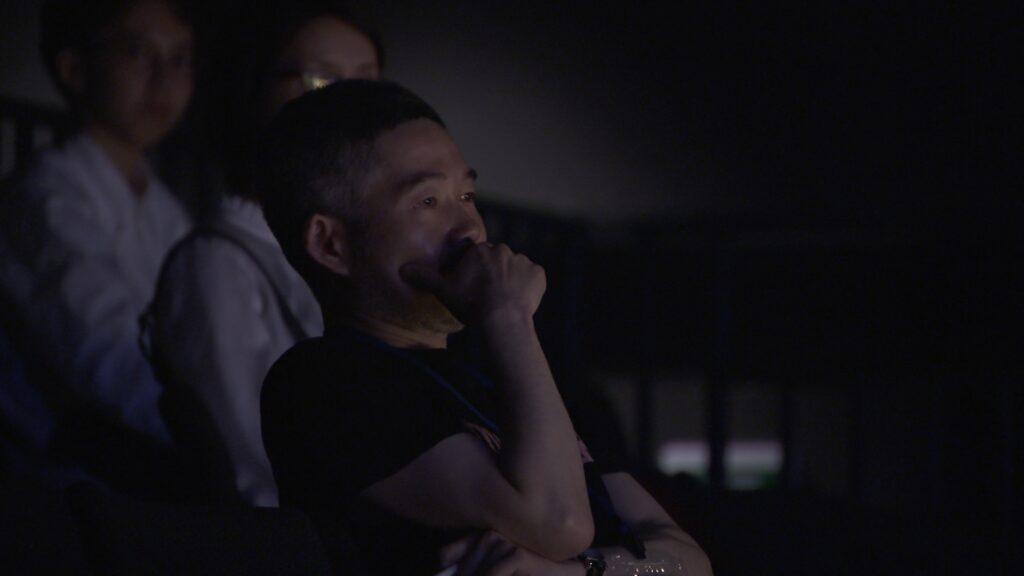
Naoki Sugawara
In recent years, we’ve seen the emergence of a wide variety of theatre productions and workshops, going beyond simply watching a play from a seat in a theatre. What are your thoughts on the future potential of theatre?
When people think of actors, they often imagine them appearing on television or performing on stage – they seem to be on the “celebrities” side. But wasn’t theatre originally something performed and shared within small communities? In Nagi Town, Okayama Prefecture, where we are currently based, rural Kabuki theatre still survives. In that sense, I hope we can revive theatre in more rural areas and make it more accessible.
Furthermore, as there are various acting techniques, whilst creating theatre with OiBokkeShi, I’ve come to think that there might be a place for a new form of theatre created by people with no acting experience, who can make good use of their life experiences.
For example, we are currently producing a piece called ‘Life Advice Heaven’; it features improvised sections with no script, so even people who find it difficult to memorise lines can take part. The plot involves life advice sessions where people exchange their views on the issues raised. It is a play where the audience watches us all think together and discuss ideas such as, ‘Perhaps we should try this’.
I’m also hoping to explore ways of breaking down the boundary between the audience and the stage. Normally, the audience comes to watch the performance, but I’m currently thinking about how we might incorporate mechanisms that allow this boundary to dissolve naturally, so that at some point, the audience members themselves become actors.
What is the message you wish to convey through the film ‘OiBokkeShi: The 99-Year-Old Leading Actor’, which chronicles the miraculous encounter between you and Okajii, your collaborative theatre-making, and Okajii’s life as a whole?
Whilst I believe it was fate and a miracle that I met Okajii, I also feel that the creation of this film was equally fateful and miraculous. I sense a sense of destiny in the fact that this film came about because Director and Cinematographer Satoshi Ohno continued to conduct interviews, Producer Tomoya Takeda launched the project, and I met Takeshi Otaka from the crowdfunding platform Motion Gallery.
Up until now, I’ve been creating works with Okajii, and whilst there have been many stories within that process, I was finding it difficult to decide how best to convey them—which is precisely when this film project was launched. And when I watched the finished film, I felt that OiBokkeShi’s 12 years of activity had been brilliantly brought together and brought to fruition.
First and foremost, I want as many people as possible to see Okajii’s life as an actor. I want those involved in creative work to see that there was someone who lived by linking daily life and art in this way. Furthermore, I would like not only young people but also older people to see how, at the age of 88 and whilst facing the challenging situation of ‘elder-to-elder care’, Okajii took the initiative to participate in a theatre workshop, learnt various things there, changed the way he interacted with his wife, and began working as a stage actor from the age of 88.I truly hope you’ll take the time to witness Okajii’s spirit of challenge.
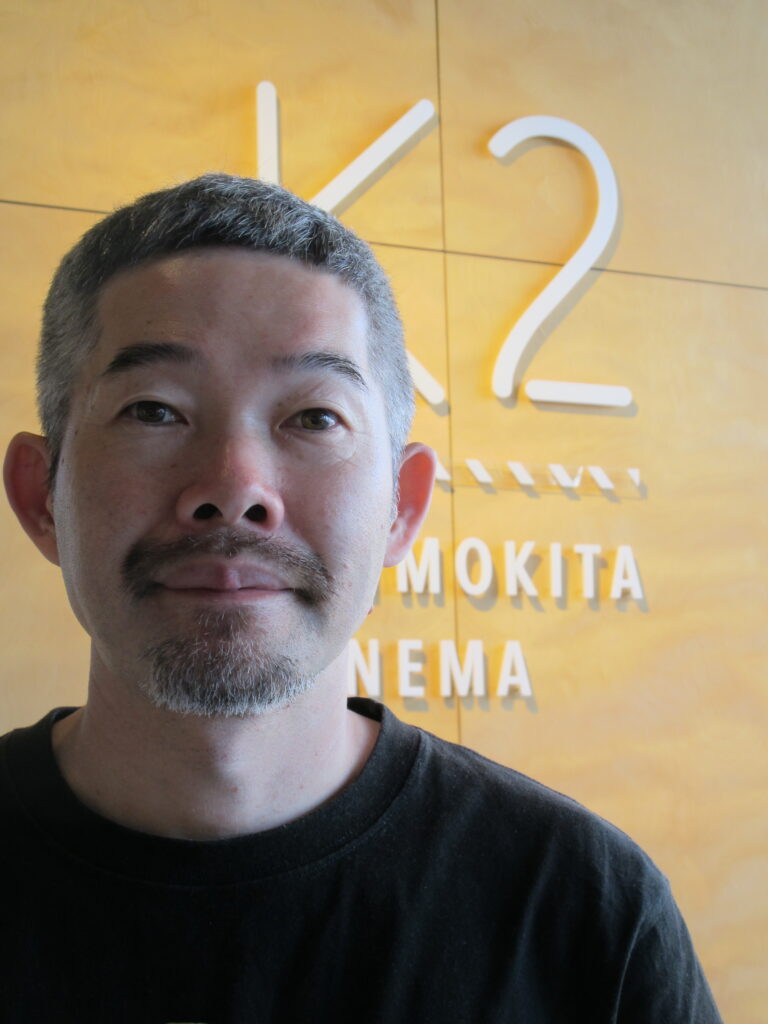
Naoki Sugawara at Shimokita Ekimae Cinema K2
OiBokkeShi: The 99-Year-Old Leading Actor
November 20 (Friday)~ Cinema Clair in Okayama (http://www.cinemaclair.co.jp/index.html?pc=1)
November 27 (Friday)~ Shimokita Ekimae Cinema K2 in Tokyo and some other cinemas
More details:https://www.ksb.co.jp/oibokkeshi_movie/